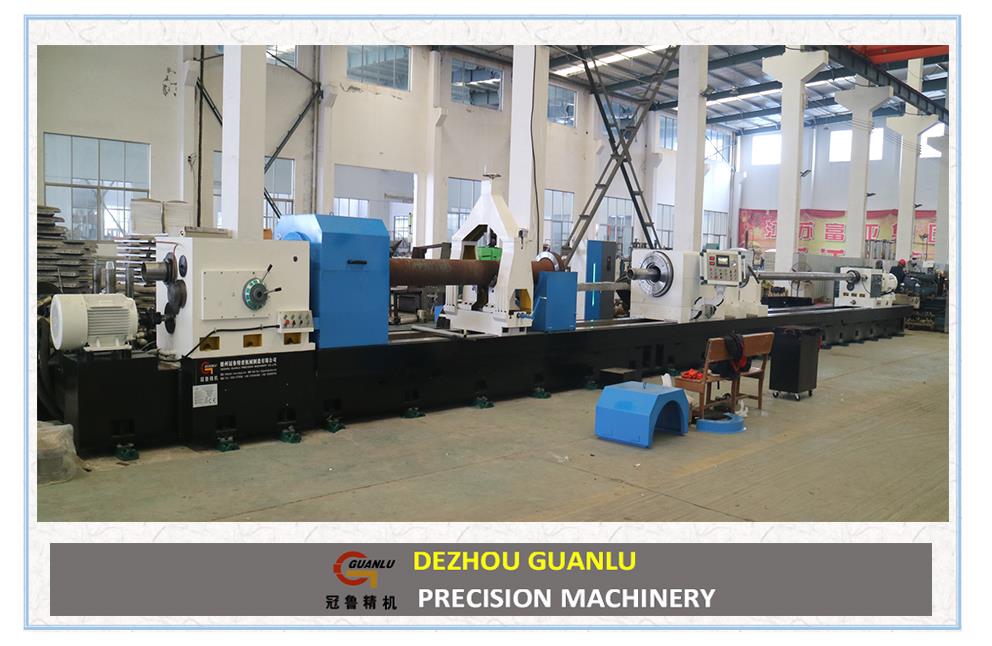


The common problems of heavy deep hole drilling and boring machine in deep hole machining of large-scale rotating parts. Based on the characteristics of deep hole machining, the clamping mode of rotating parts on the workpiece bed can only be one or two ways. One clamping and one dragging mode is that one end of the work piece is clamped by the flower tray, which not only transmits the torque but also carries the weight of the work piece, and the other end of the work piece is supported by a central frame. The two dragging modes are that the two center frames support the left and right ends of the workpiece respectively, and the flower tray is only used to transmit the torque and does not carry the weight of the workpiece.
For the workpiece with large weight and long length, there are objective deflections due to its own weight. No matter what kind of clamping method is adopted, deflection deformation cannot be avoided. Therefore, in actual operation, although the operator is at a high level, it is impossible to adjust the rotation axis of the workpiece to a straight line, so that there will be noise in the chuck claw of the work piece during rotation, damage of the center frame roller and other phenomena.
This paper analyzes the main reasons for the noise of the chuck: the surface of the chuck and the clamped workpiece is in rigid contact, and the workpiece deflects due to its own weight, resulting in uneven stress on the surface of the chuck in the axial direction. In the static state, the force on the upper claw and the lower claw is opposite in the axial direction.
In the practical solution, the copper skin is often padded between the claw and the workpiece. When the claw is subjected to a large alternating load, the copper skin is compressed and deformed, so that the uneven force on the claw surface in the axial direction can be released, which has a good effect