
Latest Products



Contact Us
Add: No.21, D Zone Jingjinluji Industry Park, Xingfu Road, Dezhou City, Shandong, China
Whatsapp/Wechat: +8615165964868
SKYPE: susanleeguobin
Email: dzguanlu@dzguanlu.com
Official webiste: www.dzgljc.com
What Is Vertical Lathe
Vertical Lathe (VTL) are machines that orient the spindle in the vertical plane in a fixed position. The workpiece then spins, moving up and down to put it in line with the cutting head. These machines are less complex than horizontal lathes.
Why Choose Us
Strong Machining Facility
Germany Heckert rail Grinder to assure the accuracy of machine bed. Chinese famous brand Planner, VMC, milling machine, boring machine, lathes.
Strong Technician And Experienced Assembling Team
Nationally famous technician teams are in our factory, who are good at design customized deep hole machines, heavy duty deep hole machines and high automatically deep hole machines.
Excellent After Sale Service
You can find us any time.7x24hours response system. No matter enquiry for new machine or after service for sold machine, our team will be responded within 7 hours. 《Machine quality assurance Contract》and 《After sale service contract》will be signed.
One-stop Solution
Offer best solution to customers.Answer all doubts for customers,provide photos,videos of the machine.
 CK 5240 Double Column Vertical Lathe For Disc Workpiece
CK 5240 Double column Vertical lathe is mainly for disc type workpiece which is large or extra large in size. It can complete inner and outer cylindrical and conical surface, inner and outer
Add to Inquiry Various Kinds Of Hydraulic Cylinder For Sale
Transport Cylinder highlights introduction: Cylinder diameter:120~460mm,working temperature-20~+80℃ Adopt high-strength material heat treatmentenhance the body hardness, coating thickness 0.25
Add to Inquiry
Vertical Lathe are similar in function to horizontal turning lathes except that the spindle is orientated vertically rather than horizontally. This design provides many advantages when it comes to CNC manufacturing.
Gravity Does the Work
One of the biggest advantages is that Vertical Lathe use gravity to set and hold a piece in place, reinforcing work holding security and process stability. In a VTL, workpiece weight is directed straight down into the machine foundation and produces no off-axis loads on the spindle.
The VTL's use of gravity also allows for lighter clamping pressures, greatly reducing the risk of damage when machining delicate pieces.
Vertical Lathe Don't Take Up a Lot of Room
Another advantage of Vertical Lathe is that they take up less floor space than horizontal turning centers. You could probably fit two Vertical Lathe into the same space occupied by a single Vertical Lathe. Adding automation, such as an OB7 cobot, can make your Vertical Lathe even more productive.
Vertical Lathe Are Cost-Effective
Another advantage of today's advanced Vertical Lathes is that they are are more affordable than ever. With the high demand for VTL-manufactured parts in the aerospace, automotive, energy, mining, and construction industries, you're ensured of a quick ROI for your business.
All About Vertical Lathe
A Vertical Lathe is a standalone lathe that has both a top and bottom. The main benefit to this design is the ability to use the top for making straight or curved grain, while the bottom can be used for crosscutting. There are primarily two kinds of VTL machines, namely, the single-side and double-side (vertical) turning lathes. The former is designed to produce short grain; whereas, the latter is meant for crosscutting purposes. Because the top of the Vertical Lathe can also be used as a turning tool, it is termed a turning machine. A Vertical Lathe consists of two spinning bars, which are attached by a spindle assembly.
Applications of Vertical Lathe
Most Vertical Lathes are designed to be mounted on a stand or workbench; however, some may be handheld. This design allows for easy mobility, even when coupled with the use of a table or similar device. Most Vertical Lathes have a variety of capabilities. The main advantage they have over a conventional milling machine is their ability to perform intricate milling operations such as crosscutting, rocking, perching, and siding.
Advantages Related to Vertical Lathe
An additional advantage of the Vertical Lathe is the fact that it can operate in a clockwise or counterclockwise motion, which eliminates the need for mechanical tools to be run into the lathe to start the operation. The fact that the spindle moves in a vertical position relative to the other bar does away with the need for a pendulum. The use of VTL allows greater control over the machining operation than with other machining methods. This is particularly evident when making intricate angled cuts, or when large amounts of material are to be moved from one side of the lathe to another.
In Conclusion of Using Vertical Lathe
The cost of operation and maintenance is higher with a Vertical Lathe due to the higher number of moving parts. Furthermore, the presence of a cutting wheel in the spindle assembly can also help in reducing the wear and tear on the other moving parts of the machine. This means that you will not need to make frequent repairs to your machine, which will save you money in the long run.
One drawback of the vertical turning centres is that they are not as portable as horizontal mounted CNC turning lathes. However, if you need to work on larger projects frequently, then it may be a better option.
Vertical vs. Horizontal Lathes

What is a lathe?
Lathes are essential machining tools that support cutting, knurling, facing, and turning operations. They have been around for thousands of years and are one of the oldest machine tools. They work in a similar way to milling machines but, instead of the tool rotating, the piece rotates. They come in a variety of forms but all lathes are essentially the same. They consist of a headstock with spindle and chuck to hold the part, a lathe bed to catch the shavings, a carriage and cross-slide to position the tool box, and a turret to mount different tools. Most modern lathes also have a tailstock that supports the end of the piece away from the chuck.
These basic two-axis machines are often used for a number of different operations, including threading, grooving, drilling, and machining complex profiles. They are the most common machining tool for cylindrical parts, like axle and sleeve components. They are a must for anyone doing heavy metal fabrication.
There are a number of factors to consider when purchasing a lathe, but the most important is the size and weight restrictions on the job at hand. A large or heavy lathe is not going to be suitable for light work, while a smaller and lighter lathe can be used for anything from small jewelry pieces to engine blocks.
While a machine is running, it's best to avoid moving or adjusting any parts of the machine unless you know what you are doing and can follow safety protocols. This is especially true if you are working on a very expensive or complicated piece of machinery. Changing the tool at the wrong time can cause damage and ruin the entire project. It is a good idea to label any areas that you are modifying and removing from the machine and to always shut off the power source completely before working on it.
What is a vertical lathe?
Vertical lathes (sometimes called VTLs) are designed to handle medium-sized to large jobs that need a solid base for holding the workpiece and eliminating any potential sagging that could happen with the same weight in the horizontal position. These machines are also known as ram-type lathes and can also perform milling tasks, allowing them to be a valuable member of any CNC machine shop.
A high-quality lathe is usually built with better materials than the cheaper machines, and it is designed to handle a wider variety of metals, making it more versatile in use.
These machines have a headstock at one end, with the tailstock at the opposite end. The chuck is mounted in the headstock, and the cutting tools are fixed on supports that can move to either side of the workpiece. The rotary motion of the tool spindle enables the cutting tools to be moved around, enabling you to shape the workpiece from various sides.
The advantage of the vertical design is that it allows for a larger overall diameter. It also eliminates the need for the tailstock to support the workpiece at its end, reducing the amount of stress on the workpiece that can be applied in the horizontal position. This is especially important for shaft work where the object is putting immense downward and lateral pressure on the part.
These lathes can be traditional engine or turret lathes, with an indexable tool turret at the headstock, or computer numerical control (CNC) versions that allow for automated machining. The machines are made of cast metal or steel blocks, and they can typically hold up to a maximum of 500 bar (7252 psi). A VTL can easily be modified for different applications, and it is very simple to load and unload workpieces.
What is a horizontal lathe?
A horizontal lathe is a type of machine tool that can rotate cylindrical workpieces and remove material from the surface to create desired shapes or surfaces. It is used in the manufacturing industry to perform heavy-duty turning operations, but it can also be programmed for other machining functions such as milling and drilling. Lathes are designed to provide high precision and stability, which makes them ideal for use in critical applications such as aerospace and medical devices.
There are different types of horizontal lathes available in the market, and they come in a variety of sizes, specifications, and price points. Choosing the right device for a particular application requires consideration of several critical factors, such as the size and power of the machine, the cost of the machine, the accuracy required by the job, and the level of automation that can be achieved.
All lathes have similar basic components, including the bed, headstock, tailstock, carriage, cross slide, tool post, and chuck. The bed holds the workpiece and provides support, while the headstock encloses the spindle and chuck that turn the piece. The tailstock supports the opposite end of the workpiece and can be adjusted to control the length of the machined part. The carriage, cross slide, and tool post hold the cutting tools. The chuck grips the workpiece and keeps it secure while the machine is cutting it.
While a horizontal lathe is best at cutting round or cylindrical workpieces, it can also be used to cut other shapes such as ovals, squares, and rectangles. It is also a popular choice for creating decorative or functional profiles, such as those seen on table legs, lamp stands, pens, and chess pieces. Other common workpieces turned on lathes include engine components, spherical joints, and precision engineering parts.
Why Choose a Vertical Lathe
The Vertical Lathe (VTL) or vertical turning centre has been a well-adopted technology for many generations. Unlike its horizontal counterpart, the VTL is configured in a different axes to provide application benefits for a variety of parts that are not particularly suited to horizontal lathes.
What is a Vertical Lathe?
In contrast to the horizontal lathe, the Vertical Lathe is configured with a machine bed that sits above the powerful driven motor. Components are clamped to the machine bed and the spindle motor below drives the rotary table and the components clamped to it. Sitting above the table is a bridge-type design with a RAM cutting tool station that lowers the cutting tool to the workpiece in the Y-axis to undertake its material removal tasks.
Since its inception, the VTL hasn't stopped evolving. New versions of vertical turning machine tools incorporate many of the productive technological innovations found in horizontal turning centres. Essentially, a vertical turning centre configuration takes a traditional lathe and stands it on its end.
The design of the VTL provides several important production and cost benefits, especially when machining large and heavy components and castings. The traditional VTL is perfect for turning heavy parts, brake discs, pump housings, aerospace and power generation parts and much more. But why?
What are the benefits of VTLs?
The Vertical Lathe is typically a large ram-type machine that can also be known as a vertical boring mill (VBM). An indexable tool turret head is what often distinguishes traditional VTLs from VBM variants. The machines are not typically high-production machines. The forte for the Vertical Lathe (VTL) is heavy-duty and high-power cutting of medium and large parts. So, what are the key factors when considering a VTL?
With parts that are often large in dimensions and weight, loading the components onto a machine bed as opposed to loading into a chuck on a horizontal turning lathe is a fundamental benefit. The gravitational pull of heavy parts on a horizontal machine can create issues with lifting and loading, set up and clamping, concentricity and subsequently clamping forces can be compromised by the centrifugal forces created by turning heavy components. All of this is eradicated with a VTL whereby the component sits on the machine bed and the subsequent clamping devices can be minimised. The result of clamping components on a bed is that stability and rigidity are increased and users can undertake heavy-duty cutting with ease. This increases productivity rates, reduces cycle times, improves tool life and surface finishes. Furthermore, by removing material in the vertical axis, chips automatically fall away from the immediate cutting area.
To undertake heavy-duty cutting, the Vertical Lathe often tends to have extremely powerful high-torque spindle motors that rotate at slower speeds than horizontal turning centres. This suits heavy-duty cutting on a stable and robust platform that is ideal for maximum material removal rates (MRR). The evolution of the VTL means that the vertical designation is now more suitable than ever for small to medium parts as well as the very large parts. Additionally, VTLs have multiple configurations for stationary and driven tools in multiple axes as well as automation that can increase the scope for these machines. And of course, in a world where floor space is an increasingly critical factor to engineers, by turning parts in the vertical axis, the VTL requires less floor space than the horizontal turning lathe. If you are interested in the benefits of the VTL, GM CNC has a range of options available for you to review.
If you are not sure which direction to take, please contact GM CNC where we have a complete range of machine tools that cover everything from 3-axis to 5-axis vertical machining centres, horizontal machining centres (HMC's), turning centres and multi-spindle turning centres as well as a host of other machines to meet your needs.
Turning is the heart of machining.Every machinist learned their craft on a horizontal lathe and if you walk into any tool room or machine shop in the world, the odds are good that you'll find at least one lathe in use. Of course, turning doesn't have to be done horizontally. Vertical lathes flip turning on its end, spinning parts like a top rather than a car tire. Inverted vertical lathes go one step further and turn vertical turning on its head.Could inverted vertical turning enhance your operation?
What is Inverted Vertical Turning?
In a vertical lathe, the chuck is located on the bottom of the machine so that parts clamped into it are pointed up. The principle benefit of this arrangement is that gravity works to your advantage for workholding, helping to seat the part.
However, with an inverted vertical lathe, the chuck is located at the top of the machine so that parts are clamped pointing down.. Using this type of lathe also means that you're moving the part toward the tool, rather than vice versa.
Advantages of Inverted Vertical Turning
So, why use an inverted vertical lathe? Kirk Stewart, Director of Sales for EMAG, LLC, offered a number of benefits to inverted vertical turning:"If you consider a part which is on a sub-spindle below the turning tool, you're basically in a situation where you are turning your chips into the tool path or the interior of the part. Those chips you're trying to remove can have a detrimental impact on the quality of the part. If the workpiece is located above the tool instead, gravity is working to your benefit to allow all the chips to escape the part without any detrimental effects on the quality of the workpiece."This means that just as with a conventional vertical lathe, gravity works to your benefit on an inverted vertical lathe. The difference is that rather than helping with workholding, gravity helps with chip removal. "The chip flow when you're machining the part is very good for the workpiece," said Stewart.This even applies to the machine's design, as Stewart explained:"It means all of our scales and rails and cables are above the work zone, and so your contamination effect is much more limited compared to a horizontal lathe or a sub-spindle lathe. Our machines tend to have a much better maintenance performance over the life of the equipment versus conventional equipment."In EMAG's case, there is another advantage to inverted vertical turning: self-loading.
"Our modular standard platform has a carousel which is loaded up with parts and offers the customer the benefit of utilizing it as a buffer, both for parts coming into the machine and parts going out of the machine," said Stewart. "The result is that customers don't need to invest in any additional, third party automation, yet are able to run their machines in a fully automatic cycle without any downtime due to loading and unloading of the workpiece."
Applications for Inverted Vertical Turning
As with any turning operation, the applications for inverted vertical turning all involve round parts. For example, "any gear that you'd put in an automatic transmission," said Stewart. Of course, it doesn't end with transmissions.Differential ring gears, pinion gears, planetary carriers, hubs, flanges and yokes of various sizes can all be produced using an inverted vertical lathe. "EMAG machines are designed for parts as small as 1 inch, all the way up to 54 inches," said Stewart.For high volume applications typical in the automotive, appliance and consumer goods industries, inverted vertical turning is ideal where pick-and-place robotics caps line speed, or where the configuration of transfer lines makes it difficult to integrate a conventional turning center.Many press-fit or shaft assembly operations, for example, are performed in vertical setups, reducing the need to reorient parts for downstream processes as they come off the vertical center. Similarly, the carousel's built in "buffer" can replace accumulator systems between the turning center and downstream processes, reducing line stoppages when out-of-tolerance parts are detected and removed. And with gravity allowing minimal swarf and coolant residue on the parts, cleaning prior to downstream operations can be simplified or eliminated entirely.
Is Inverted Vertical Turning Right for You?
If you're working with round parts, then you'll more than likely need turning. When it comes to inverted vertical turning, volume is the key. "Any round part that needs to be turned and which has some volume behind it is going to benefit from our machines' self-loading," said Stewart, before adding the caveat that, "This is not a machine that would do well in the environment of a job shop. Job shops require a lot of input from the operator on a case-by-case basis. But for any round part that has any volume, if you're setting up for a thousand-part run, you can be assured that the machine will be very efficient in the process."
Inverted vertical turning may flip the process on its head, but it's still a machine tool, and standard machine tool practice still holds true, from toolpath coding to speeds and feeds.For manufacturers contemplating machining cells using general purpose robotics tending two or more horizontal centers to feed a hungry line, inverted vertical turning offers lower overall cost in a smaller footprint with high throughput.Vertical turning has been around for over a century, but if it was invented today, engineers would identify it as made for automated part production. Inverting the process lets smart manufacturers take full advantage of gravity; it's like a free actuator or additional axis, without the cost or complexity.
Our factory
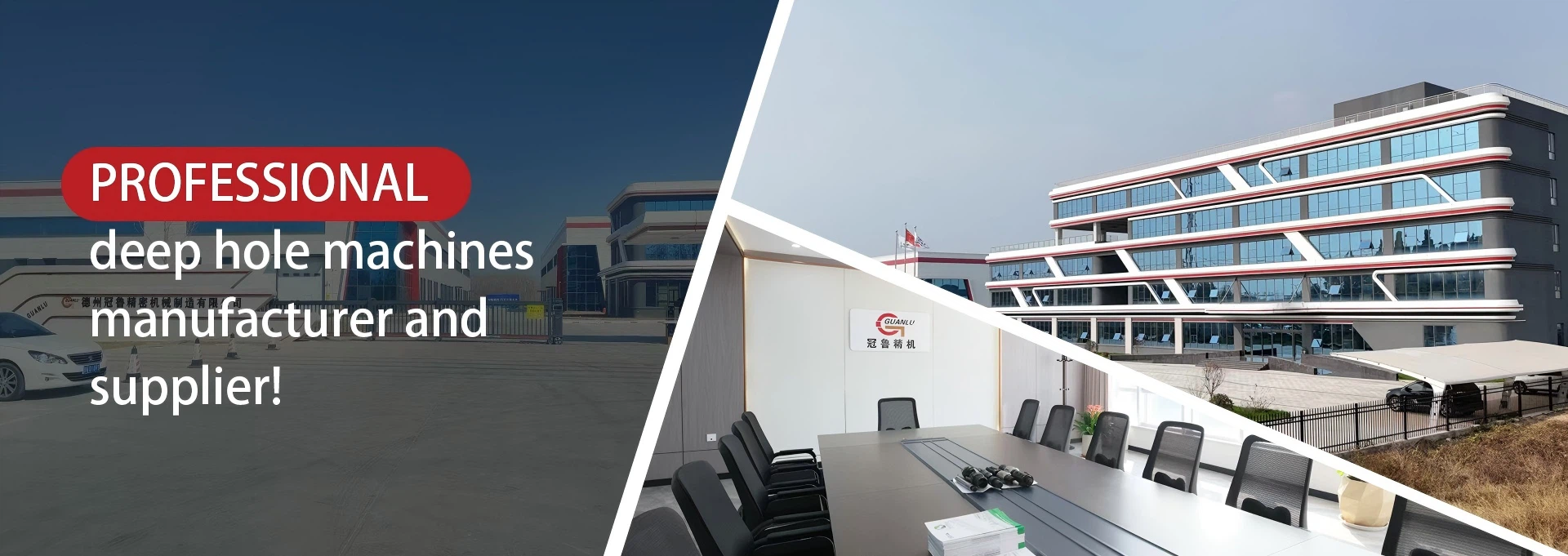
Dezhou Guanlu Precision Machinery Co.,Ltd is founded in 2011,its main business is manufacturing: Gun drilling machine,deep hole drilling machine,BTA deep hole drilling machine,deep hole skiving burnishing machines,deep hole honing machines and toolings.Our factory had about 50 workers,10technical engineers,15000square meters workshop.

FAQ
Q: What is the purpose of a vertical lathe?
Q: What is the difference between a vertical and horizontal lathe?
Q: What is the vertical turning process?
Q: Which type of lathe machine is mostly used and why?
Q: What is a horizontal lathe used for?
Q: Which lathe is more accurate?
Q: Which is better vertical or horizontal milling machine?
Q: What is better vertical or horizontal mill?
Q: Why lathe is called mother of all machines?
Q: What is the most common lathe machine?
Engine lathes, the most common type, are versatile and suitable for various turning operations. They feature manual controls and are ideal for turning cylindrical workpieces.
Q: What is the vertical milling method?
Q: How does a vertical milling machine work?
Q: What is the most basic manual lathe?
Q: What is the difference between a lathe and a turning machine?
Q: What should I avoid using a lathe machine?
Q: What is a good size lathe?
Q: Why is horizontal better than vertical?
Q: Why are lathes so expensive?
Q: What are the three different types of lathes?
Q: What is the main difference between horizontal and vertical?
As one of the leading hydraulic cylinder manufacturers and suppliers in China, we warmly welcome you to wholesale cheap hydraulic cylinder for sale here from our factory. All customized products are with high quality and competitive price.
