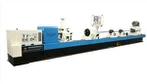


How to judge chip removal and bit wear through the cutting condition of deep hole drill? Mainly through the following six points:
(1) Cutting cannot be observed directly. Judging chip removal and bit wear only by sound, chip, machine load, oil pressure and other parameters.
(2) Cutting heat is not easy to spread out.
(3) It is difficult to remove chips. If the chips are blocked, the drill bit will be damaged.
(4) Due to the long, poor rigidity and easy vibration of the drill pipe, the hole axis is easy to deviate, affecting the machining accuracy and production efficiency.
(5) The coaxiality of the center lines of the spindle, tool guide sleeve, tool rod support sleeve and workpiece support sleeve shall meet the requirements; The cutting fluid system shall be unblocked and normal; There shall be no central hole on the machined end face of the workpiece, and drilling on the inclined plane shall be avoided; The chip shape shall be kept normal to avoid the generation of straight strip chips; The through hole shall be processed at a higher speed. When the drill bit is about to be drilled through, the speed shall be reduced or shut down to prevent damage to the drill bit.
(6) Cutting oil for deep hole machining: a large amount of cutting heat will be generated in the process of deep hole machining, which is not easy to diffuse. It is necessary to supply sufficient cutting fluid to lubricate and cool the tool. Generally, 1:100 emulsion or extreme pressure emulsion is selected; When high machining accuracy, surface quality or machining toughness materials are required, extreme pressure emulsion or high concentration extreme pressure emulsion shall be selected. The kinematic viscosity of cutting oil is usually 10 ~ 20cm2 / S (40 ℃), and the flow rate of cutting oil is 15 ~ 18m / S; Select cutting oil with low viscosity when machining diameter is small; For deep hole machining requiring high precision, the cutting oil ratio can be 40% extreme pressure sulfide oil, 40% kerosene and 20% chlorinated paraffin.